




Our 1-Call Alaska Alternative Planning Criteria program provides 24/7 support to vessels transiting the Alaskan EEZ, the most economic pathway for commerce between ports in Asia to the west coast of North America.
Resolve 1-Call Alaska is a U.S. Coast Guard-approved Alternative Planning Criteria (APC) program administrator for the Western Alaska Captain of the Port (COTP) and Prince William Sound COTP Zones, providing federally recognized alternatives where National Planning Criteria (NPC) are impractical due to Alaska's remoteness and lack of infrastructure.
Our APC programs are designed to close the gap between regulatory intent and operational reality, combining risk mitigation, prevention measures, and staged response capability to meet VRP requirements under 33 CFR Part 155.
Unlike APC administrators that focus solely on paperwork and mitigation measures, Resolve integrates salvage engineering, marine firefighting readiness, and source control expertise directly into our APC framework. This allows us to intervene earlier, assess vessel stability and structural risk, and reduce the likelihood that a casualty becomes an environmental release.
Our APC participants span the full spectrum of global shipping from bulk carriers and container vessels to cruise ships, tank vessels, and specialized operators sailing across Alaska's most remote regions.
Applicability
Spill response planning requirements in Western Alaska depend on how your vessel is operating and where activities occur. Federal APC Coverage is Required When Your Vessel:
- Is subject to a US Coast Guard Vessel Response Plan (VRP), and
- Is operating in, or is on a non-innocent passage through, the Western Alaska Captain of the Port (COTP) Zone
A non-innocent passage is defined as a voyage bound to or from a US port or place, or when conducting operations within the applicable EEZ.
1-Call Alaska APC Coverage AreasNontank Vessels: Entire Western Alaska & Prince William Sound COTP Zones
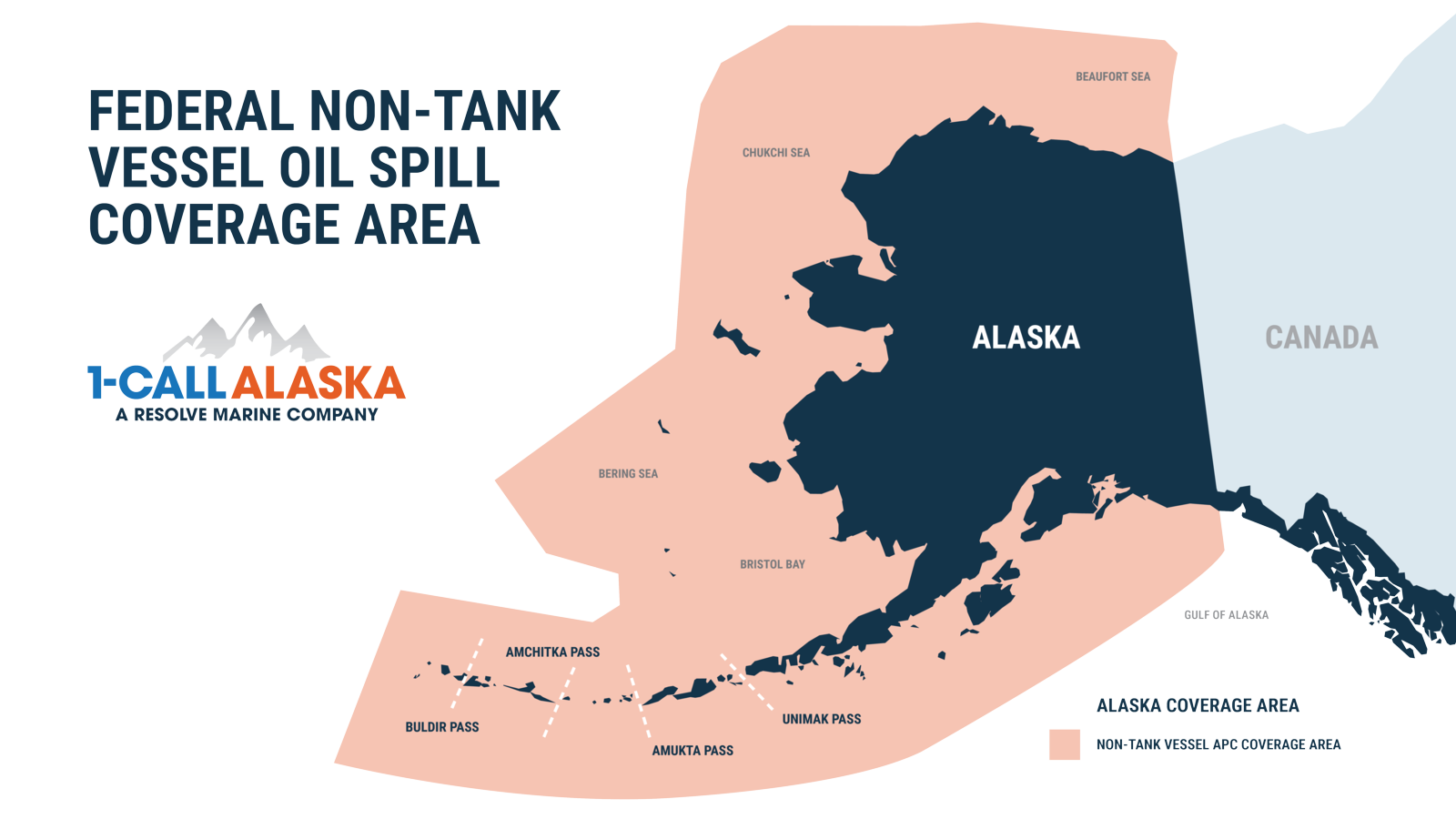
Tank Vessels: From 63° North latitude to the eastern boundary of the Prince William Sound COTP Zone
.png)
Enrollment Made Easy
Resolve 1-Call Alaska offers the most streamlined path to APC regulatory compliance, minimizing administrative burden while fully meeting OPA 90 regulations. Enrollment is simple and efficient, requiring just three steps for plan holders to obtain coverage:
Step 1: Execute a Signed APC Agreement
Complete an applicable tank or non-tank 1-Call Alaska's APC Agreement, already reviewed and accepted by the U.S. Coast Guard and the International Group of P&I Clubs. Plan holders can proceed with confidence, without the need for additional underwriter approvals or commercial negotiations.
Step 2: Submit Required Vessel Information and Contact Details
Gather the following vessel details:
- Vessel Name
- IMO Number
- MMSI Number
- Vessel Worst Case Discharge Volume (in barrels)
- Vessel Email Address
- Vessel SAT Phone Number
Step 3: Submission, Rapid Review and Certification
Submit the above to Resolve's Client Services Team at opacompliance@resolvemarine.com
Once received and confirmed to be in good order, Resolve can issue APC certification and associated compliance documentation within 24 hours, delivering speed, clarity, and regulatory peace of mind.
Fleet-Wide Enrollment Recommended
For operators with dynamic trading patterns, Resolve recommends fleet-wide enrollment under the 1-Call Alaska program. Fleet enrollment allows owners and managers to pre-establish APC coverage across their fleet, eliminating last-minute compliance actions if additional vessels route through Western Alaska on a non-innocent passage.
There is no enrollment fee to establish fleet coverage. Charges apply only if and when a vessel completes a covered transit, keeping compliance predictable, flexible, and aligned with operational reality.
Links & Downloads